
Patios in Ashton-in-Makerfield
Patios built from the ground up in porcelain, Indian stone or traditional flagging, set on a full mortar bed over a compacted sub-base, with falls that carry rainwater away from your house and finish below the damp course. Around five miles from our Leigh base.
Patios for Ashton-in-Makerfield Gardens
Ashton gardens tend to have one corner that holds the sun long after the rest has gone cold, and that’s where a patio belongs. We find that spot first and build the seating area to suit it, rather than defaulting to a slab by the back door that’s in shade by mid-afternoon.
We cover Ashton-in-Makerfield and the surrounding area: Bryn, Garswood, Stubshaw Cross, Town Green, North Ashton and beyond (WN4).
Get a Free Ashton-in-Makerfield Quote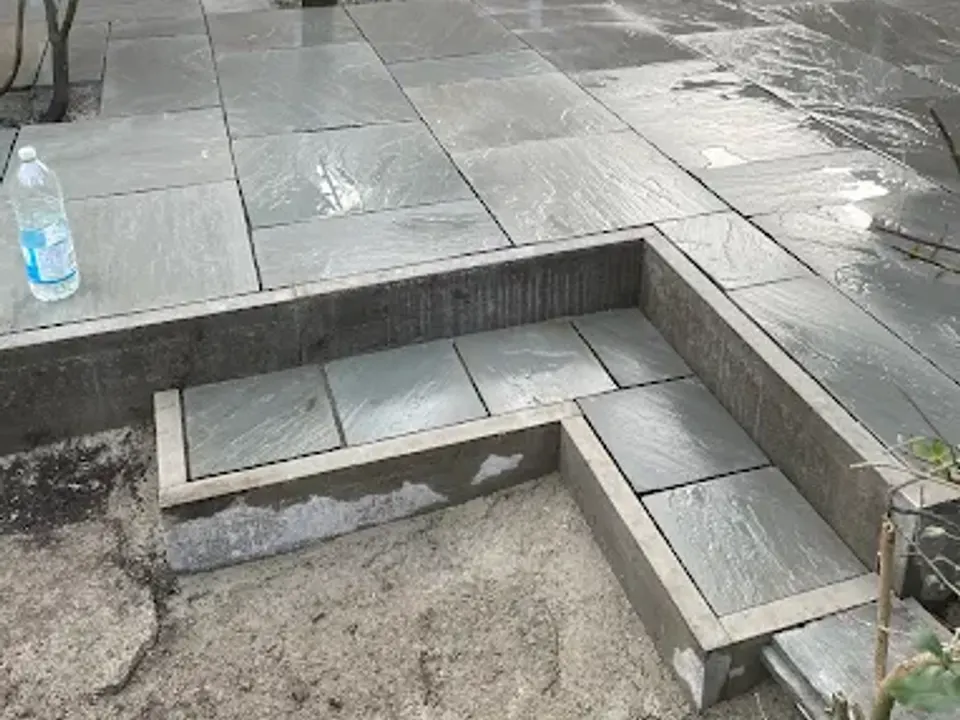
What’s Included
Porcelain, Indian stone and traditional flagging are the three we lay, and the choice is a straight trade-off: porcelain is flattest and lowest upkeep but dearest, Indian stone is natural and cheaper, flagging is the plain honest option. Every flag goes on a full mortar bed over a compacted base, which matters all the more on Ashton’s soft coalfield fill, with the falls set away from the house below the damp course and the joints filled so weeds stay out.
- Porcelain, Indian stone and traditional flagging
- Full dig-out and compacted MOT Type 1 sub-base
- Every flag on a full mortar bed, not five dabs
- Falls set so water runs away from the house
- Finished below the damp proof course as standard
- Joints filled with mortar or resin against weeds
- Sunken or rocking flags lifted and relaid
How It Works
Patios in Ashton-in-Makerfield, FAQs
Wherever the sun lands late in the day, which often isn’t next to the house. We’ll watch how the light moves across your plot and put the seating in the warm corner. It’s the difference between a patio you use all summer and one that sits empty.
Yes, a slope is dealt with using levels, a step or a low retaining course, all worked out before we start. What matters is that the finished surface falls gently away from the house so water runs off, and we build those falls in from the sub-base up.
Porcelain is dense, colour-consistent and barely stains, so a porcelain patio stays looking new with almost no upkeep, but it costs more and needs a skilled lay. Indian stone is natural, so every flag varies, and it weathers into the garden nicely at a lower price, though it benefits from an occasional clean and seal. Neither is wrong; it comes down to the look you want and the budget you’re working to.
A typical patio runs three to five days: dig-out and sub-base first, then the laying, then jointing once the beds have firmed up. Wet weather can stretch things slightly because mortar and jointing compounds need time to cure, and we’d rather wait a day than joint onto a bed that isn’t ready.
Nine times out of ten it was laid on sand or dabs of mortar with no proper sub-base, so the ground underneath has settled. If it’s a few flags, we can lift and relay them on fresh full beds, or repoint where the joints have just washed out. If the base has failed across the whole area, relaying the lot on a compacted sub-base is the honest fix, because patching a bad base only moves the problem along.