
Patios in Newton-le-Willows
Patios built from the ground up in porcelain, Indian stone or traditional flagging, set on a full mortar bed over a compacted sub-base, with falls that carry rainwater away from your house and finish below the damp course. Around five miles from our Leigh base.
Patios for Newton-le-Willows Gardens
Most new-build gardens in Newton-le-Willows come with a token patio, a couple of flags by the back door that hold a bin and little else. Building that out into a proper patio is one of the jobs that transforms these plots, giving you a real space to sit and eat out where there was none.
We cover Newton-le-Willows and the surrounding area: Earlestown, Wargrave, Vulcan Village, Newton in Makerfield, Tayleur Leas and beyond (WA12).
Get a Free Newton-le-Willows Quote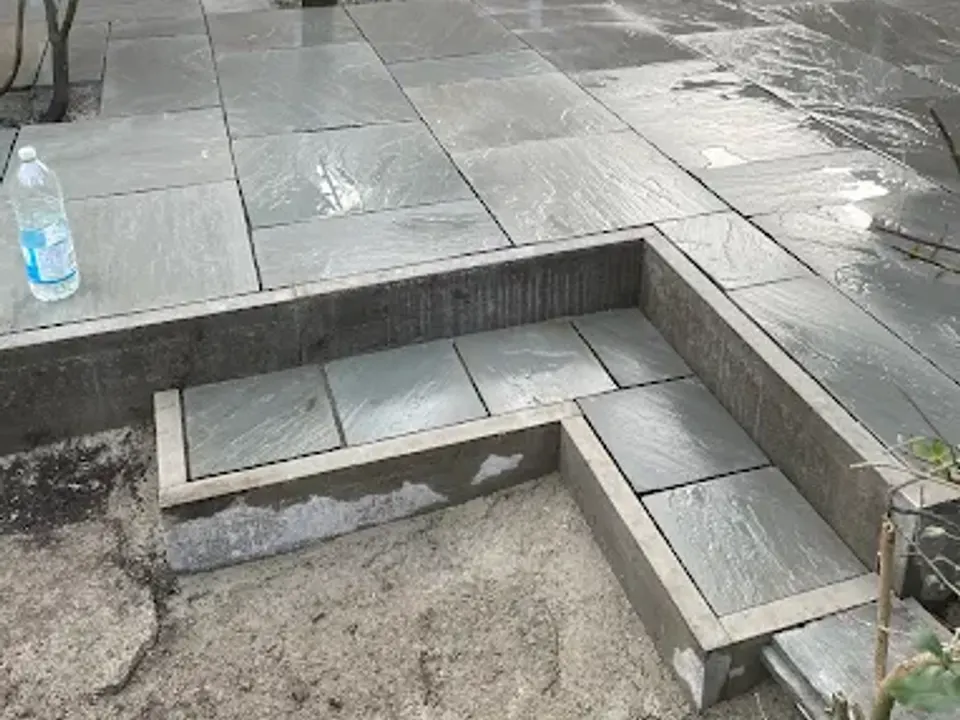
What’s Included
We lay porcelain, Indian stone or traditional flagging, and it’s an honest trade-off between them: porcelain is flattest and lowest maintenance but dearest, Indian stone is natural and cheaper, flagging is the plain workhorse. Whatever you choose goes on a full mortar bed over a compacted base, with the falls set away from the house below the damp course and the joints filled so weeds can’t get in. On compacted new-build ground that base work is what keeps it flat.
- Porcelain, Indian stone and traditional flagging
- Full dig-out and compacted MOT Type 1 sub-base
- Every flag on a full mortar bed, not five dabs
- Falls set so water runs away from the house
- Finished below the damp proof course as standard
- Joints filled with mortar or resin against weeds
- Sunken or rocking flags lifted and relaid
How It Works
Patios in Newton-le-Willows, FAQs
Yes, and it usually looks better rebuilt than patched onto. We either lift and relay the original flags into the new layout or start fresh, so you end up with one consistent surface instead of an obvious add-on beside the builder’s slabs.
Falls carry rainwater away from the house instead of letting it pool against the wall, and the finished surface has to sit below the damp course so damp can’t bridge into the brickwork. We set both correctly when we build, which the original builder’s flags often don’t.
Porcelain is dense, colour-consistent and barely stains, so a porcelain patio stays looking new with almost no upkeep, but it costs more and needs a skilled lay. Indian stone is natural, so every flag varies, and it weathers into the garden nicely at a lower price, though it benefits from an occasional clean and seal. Neither is wrong; it comes down to the look you want and the budget you’re working to.
A typical patio runs three to five days: dig-out and sub-base first, then the laying, then jointing once the beds have firmed up. Wet weather can stretch things slightly because mortar and jointing compounds need time to cure, and we’d rather wait a day than joint onto a bed that isn’t ready.
Nine times out of ten it was laid on sand or dabs of mortar with no proper sub-base, so the ground underneath has settled. If it’s a few flags, we can lift and relay them on fresh full beds, or repoint where the joints have just washed out. If the base has failed across the whole area, relaying the lot on a compacted sub-base is the honest fix, because patching a bad base only moves the problem along.