
Decking in Bolton
Timber and composite decking supplied and fitted: raised decks, steps and balustrades built on solid subframes that stay level, safe and dry underneath. Around eight miles from our Leigh base.
Decking for Bolton Gardens
Bolton gardens climb hills, and that is precisely where decking beats every other surface. A plot that falls a metre from fence to fence needs retaining walls and serious muck-shifting before you can pave it, but a deck frame just spans the drop and hands you a level terrace with a view. We build split-level and raised decks across the south and west side of Bolton, from Ladybridge to Westhoughton borders.
We cover Bolton and the surrounding area: Deane, Daubhill, Ladybridge, Hunger Hill, Middle Hulton and beyond (BL1, BL3, BL5, BL6).
Get a Free Bolton Quote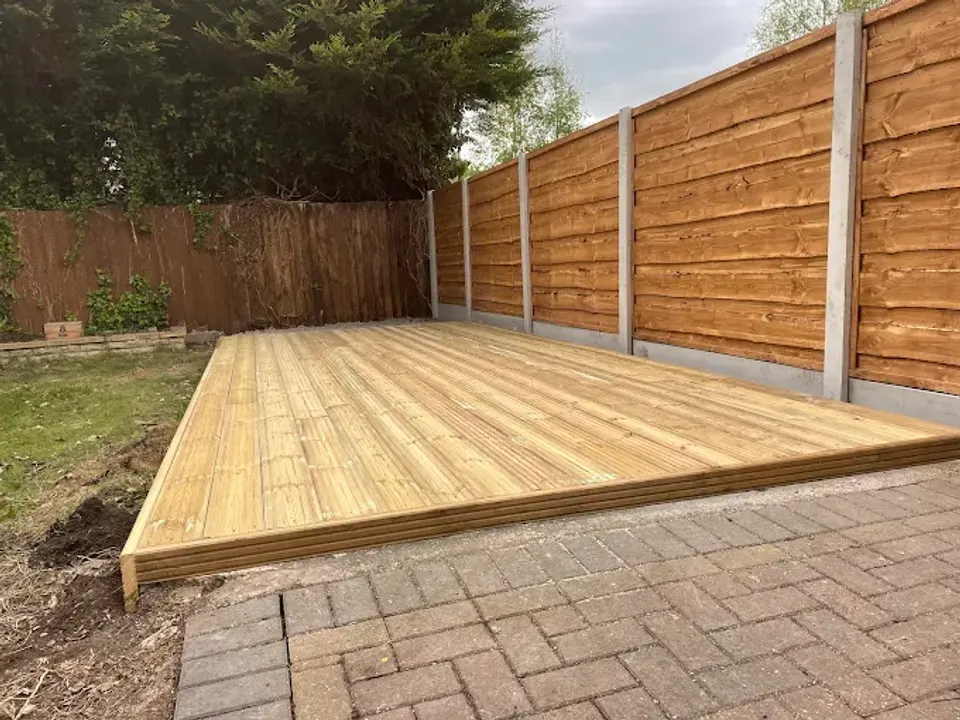
What’s Included
Bolton weather works exposed timber hard, so our frames here are belt and braces: galvanised or coated fixings throughout, posts on solid pads, and board gaps set for drainage. On the blowy plots we talk honestly about composite, which shrugs off the wet, and about balustrades, which raised decks on a slope genuinely need.
- Treated timber decking, supplied and fitted
- Composite decking in a range of colours and finishes
- Raised and split-level decks for sloped gardens
- Steps, balustrades and handrails built in
- Solid subframes with membrane and airflow underneath
- Old decking removed and taken away
How It Works
Decking in Bolton, FAQs
We have not met it yet. Steeper plots just mean taller posts, more bracing and usually a split level so the deck steps down with the garden. The engineering is routine, and it is still far less upheaval than cutting and retaining the slope for paving.
It ages them faster than most, honest answer. Wind-driven rain plus shade is a hard life for softwood, so up here composite repays its extra cost quickly. If you prefer timber we build it with coated fixings and spec an oiling routine that keeps it ahead of the weather.
It comes down to budget and appetite for upkeep. Treated timber is cheaper to buy and easy to repair, but needs a clean and re-oil every year or two to stay looking good. Composite costs more up front and then more or less looks after itself. In shaded gardens where timber greens over fast, composite is usually worth the extra.
Yes, and that is where decking beats paving hands down. The frame takes up the slope, so you get a perfectly level surface without moving tonnes of soil. Split-level decks with a step or two between them work well on steeper plots.
Any surface grows algae in a shaded, damp spot. Grooved boards help, composite ranges with textured finishes help more, and an annual wash keeps either surface safe. If the deck is going somewhere that never sees sun, tell us and we will spec the boards accordingly.