
Decking in Walkden
Timber and composite decking supplied and fitted: raised decks, steps and balustrades built on solid subframes that stay level, safe and dry underneath. Around six miles from our Leigh base.
Decking for Walkden Gardens
Walkden sits on heavy clay, and most people who garden here know the soggy corner that never really dries out. Decking is the practical fix: the frame lifts your seating area clear of the wet ground, air moves underneath, and the boards stay usable when the lawn is still squelching in April. We build timber and composite decks across Walkden and Little Hulton.
We cover Walkden and the surrounding area: the town centre, Hill Top, Parr Fold, Linnyshaw, Walkden North and beyond (M28).
Get a Free Walkden Quote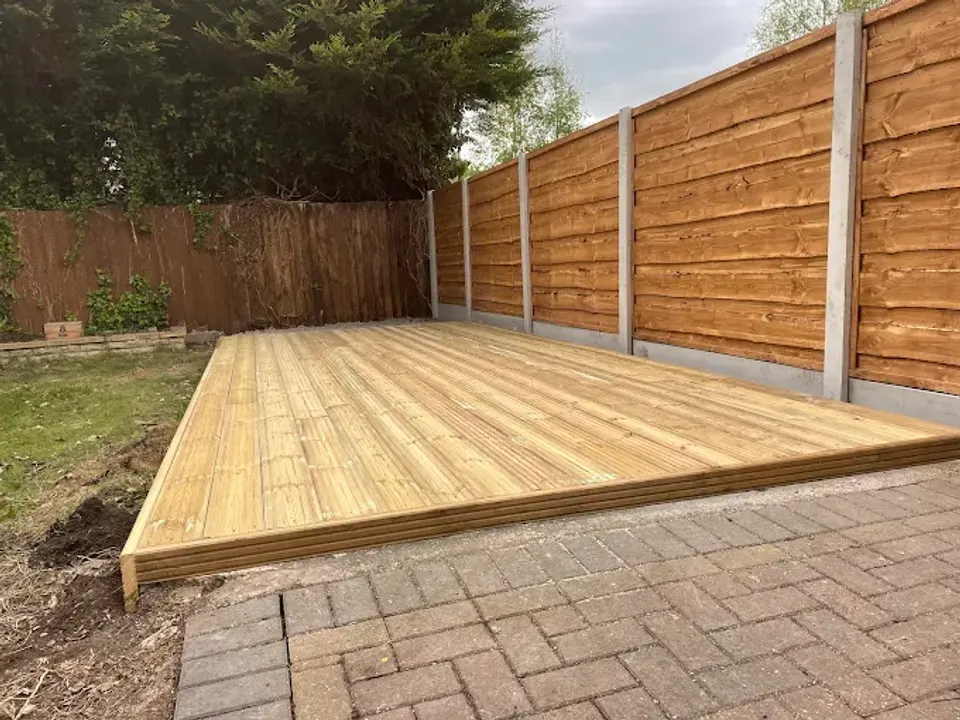
What’s Included
On clay we set posts on generous pads so nothing heaves or sinks with the seasons, and we always fit the membrane, because clay grows weeds through any gap it finds. Raised decks get balustrades built in, and composite boards are worth a hard look here since damp-climate timber wants more frequent care.
- Treated timber decking, supplied and fitted
- Composite decking in a range of colours and finishes
- Raised and split-level decks for sloped gardens
- Steps, balustrades and handrails built in
- Solid subframes with membrane and airflow underneath
- Old decking removed and taken away
How It Works
Decking in Walkden, FAQs
It fixes the using-the-garden part immediately, because you are up off the wet ground on a dry, level platform. If the bog itself bothers you we can add drainage underneath while the ground is open, but plenty of customers find the deck alone solves the problem they actually had.
Not if it is built to breathe. The failures you hear about come from frames sat in contact with wet soil and sealed in with no airflow. Ours sit on pads above the ground with air moving underneath, which is exactly how a deck survives Walkden clay.
It comes down to budget and appetite for upkeep. Treated timber is cheaper to buy and easy to repair, but needs a clean and re-oil every year or two to stay looking good. Composite costs more up front and then more or less looks after itself. In shaded gardens where timber greens over fast, composite is usually worth the extra.
A properly built timber deck on a sound subframe should give you 15 years or more with basic care. Quality composite boards are typically guaranteed for 20 to 25 years. In both cases the subframe matters more than the boards, which is why we never skimp on it.
Yes, and that is where decking beats paving hands down. The frame takes up the slope, so you get a perfectly level surface without moving tonnes of soil. Split-level decks with a step or two between them work well on steeper plots.