
Decking in St Helens
Timber and composite decking supplied and fitted: raised decks, steps and balustrades built on solid subframes that stay level, safe and dry underneath. Around nine miles from our Leigh base.
Decking for St Helens Gardens
The post-war semis around Blackbrook, Moss Bank and the east side of St Helens usually come with a cracked concrete pad where the garden meets the house, poured sixty years ago and showing it. Decking is the tidy way past it: build over the concrete, square the area up properly, and the garden gains a level terrace without a breaker ever starting up. We fit timber and composite decks across the east side of St Helens.
We cover St Helens and the surrounding area: Haydock, Blackbrook, Parr, Moss Bank, Broad Oak and beyond (WA9, WA10, WA11).
Get a Free St Helens Quote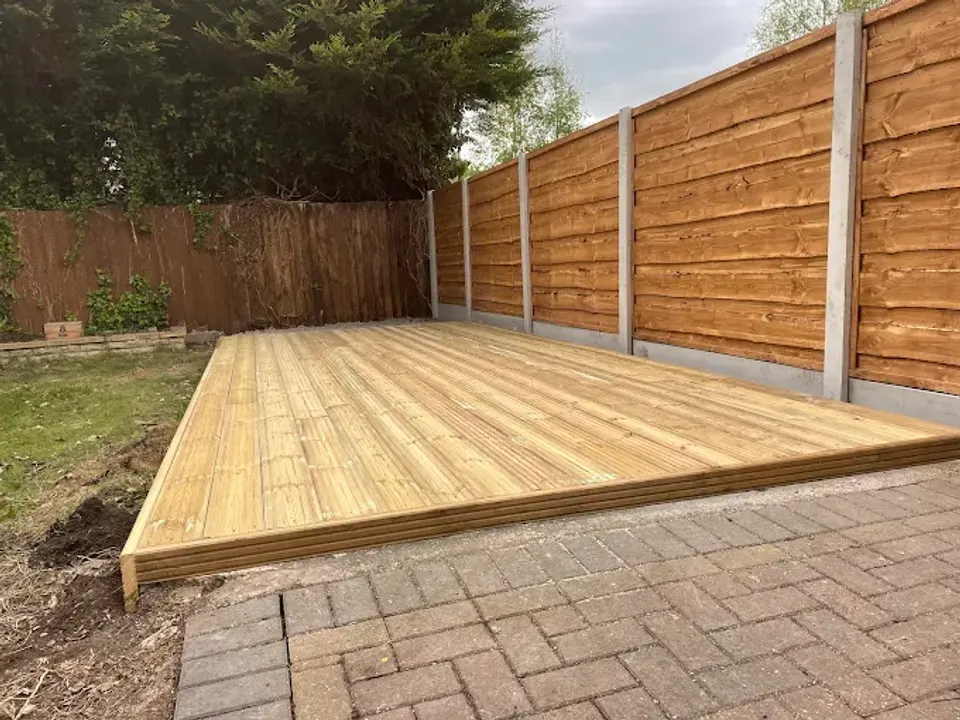
What’s Included
Working over old slabs, we pack the frame level off the sound sections and bridge the broken ones, checking the water still runs away underneath. Boards, steps and rails to suit the house, old timber and debris away on the van, and the whole job typically wrapped inside a week.
- Treated timber decking, supplied and fitted
- Composite decking in a range of colours and finishes
- Raised and split-level decks for sloped gardens
- Steps, balustrades and handrails built in
- Solid subframes with membrane and airflow underneath
- Old decking removed and taken away
How It Works
Decking in St Helens, FAQs
Nearly always, and it is the cheapest route to a good result. The slab becomes a ready-made foundation: we level the frame off it and the cracks and stains disappear under the boards. We only break concrete out when it is heaved badly enough to trap water.
The east side sits naturally in our patch: Blackbrook, Moss Bank, Haydock and Parr slot into the rounds we already run through Ashton-in-Makerfield and Newton-le-Willows. Quotes are free and written, wherever you are on that side of town.
It comes down to budget and appetite for upkeep. Treated timber is cheaper to buy and easy to repair, but needs a clean and re-oil every year or two to stay looking good. Composite costs more up front and then more or less looks after itself. In shaded gardens where timber greens over fast, composite is usually worth the extra.
A properly built timber deck on a sound subframe should give you 15 years or more with basic care. Quality composite boards are typically guaranteed for 20 to 25 years. In both cases the subframe matters more than the boards, which is why we never skimp on it.
Yes, and that is where decking beats paving hands down. The frame takes up the slope, so you get a perfectly level surface without moving tonnes of soil. Split-level decks with a step or two between them work well on steeper plots.