
Decking in Wigan
Timber and composite decking supplied and fitted: raised decks, steps and balustrades built on solid subframes that stay level, safe and dry underneath. Around seven miles from our Leigh base.
Decking for Wigan Gardens
Wigan gardens run from Victorian villas around Swinley and Whitley to modern estates on the edges, and decking works hard in both. On the period side, a composite deck gives a big garden a low-maintenance terrace that does not fight the house. On the estates, a neat timber deck sorts the standard-issue small garden into something you use. We build both across WN1 to WN6.
We cover Wigan and the surrounding area: Scholes, Whelley, Swinley, Beech Hill, Worsley Mesnes and beyond (WN1, WN2, WN3, WN6).
Get a Free Wigan Quote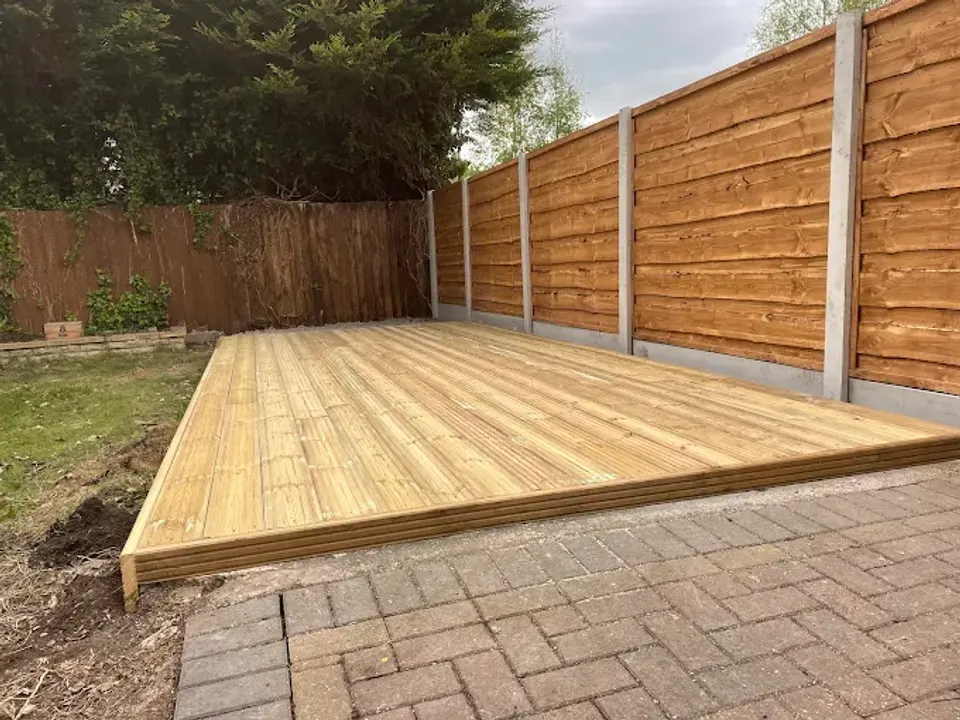
What’s Included
The build does not change with the postcode: solid pads, a frame at proper centres, membrane, airflow, then boards fixed cleanly with hidden fixings on composite ranges that support them. Steps, split levels and balustrades are designed in from the first visit, and we cart away whatever we strip out.
- Treated timber decking, supplied and fitted
- Composite decking in a range of colours and finishes
- Raised and split-level decks for sloped gardens
- Steps, balustrades and handrails built in
- Solid subframes with membrane and airflow underneath
- Old decking removed and taken away
How It Works
Decking in Wigan, FAQs
Yes, if it is detailed right. On period plots around Swinley or Springfield we tend to keep decks low, wide and simply railed so they read as a garden terrace rather than a bolt-on. Darker composite tones sit particularly well against brick and mature planting.
We do. Our Leigh base is around seven miles out, and we work across the whole borough: Whelley, Standish side, Pemberton, Orrell and everywhere between. Site visits and written quotes are free wherever you are in WN1 to WN6.
It comes down to budget and appetite for upkeep. Treated timber is cheaper to buy and easy to repair, but needs a clean and re-oil every year or two to stay looking good. Composite costs more up front and then more or less looks after itself. In shaded gardens where timber greens over fast, composite is usually worth the extra.
Yes, and that is where decking beats paving hands down. The frame takes up the slope, so you get a perfectly level surface without moving tonnes of soil. Split-level decks with a step or two between them work well on steeper plots.
Any surface grows algae in a shaded, damp spot. Grooved boards help, composite ranges with textured finishes help more, and an annual wash keeps either surface safe. If the deck is going somewhere that never sees sun, tell us and we will spec the boards accordingly.